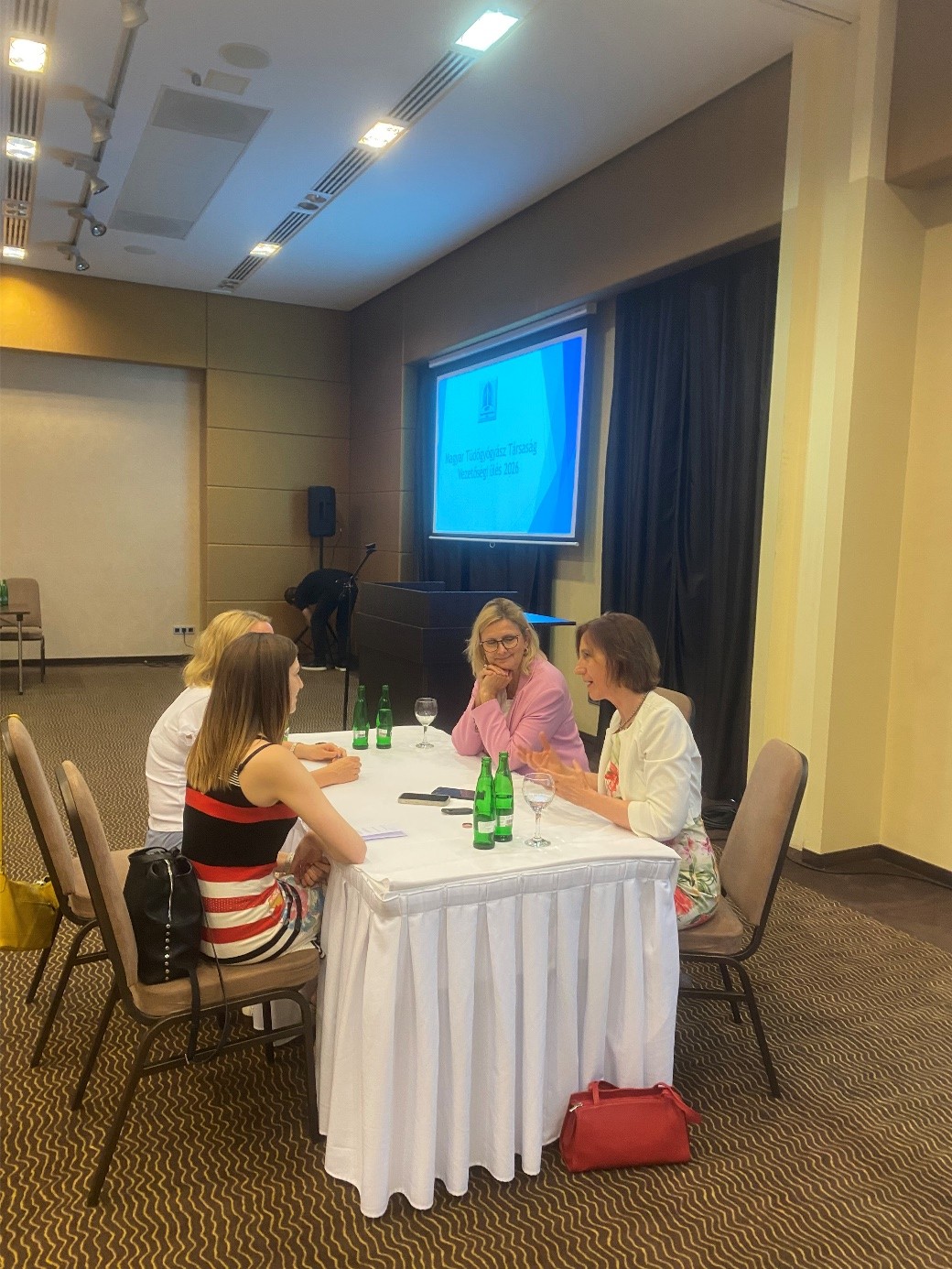
Short interview with the President and Secretary of the European Respiratory Society
2026. 09. 07. |
We were lucky to have a short interview with Prof. Ildikó Horváth (secretary, ERS) and Prof. Joanna Chorostowska-Wynimko (president, ERS) at the recent meeting of the executive committee of the Hungarian Respiratory Society, held in Herceghalom on 29 August.
Dr Lázár: What would be the 5 most important pieces of advice that you would give to residents in respiratory medicine from Hungary when they join the ERS?
Prof. Chorostowska-Wynimko: First of all, the ERS is the respiratory society, so it's where anyone interested in breathing comes together. Second: opportunities; third: networking; fourth: fun and pleasure of being among your colleagues; fifth: funding.
Prof. Horváth: I would like to add that you co-create the future of this society with other members and participants. You probably gain lifelong friendships inside this community. This is the community where we grew up in many ways, and this friendship really links you not only to the topic, naturally, for better patient care, but also to something that you can bring back to your smaller community here as well. Of course, it will encourage you to see how others do their care and how they do their research, to collaborate or learn from that, or you can offer what you have already learned, and your experience from this diversity that we have; you can really become a better doctor in many ways, and a better person as well. So friendship, cooperation, diversity and self-growth and very productive research and probably publications, so a very attractive career pathway which will contribute to your career in pulmonology.
Dr Czibula: If there is a young pulmonologist who has just started their career and wants to join international research but doesn't have any connections, how should they start? What would you recommend as a good strategy?
Prof. Chorostowska-Wynimko: ERS makes it really easy. Even if you have no idea whom to approach, if you have a specific interest, make sure you attend specific sessions at the ERS congress, whether a lecture or a poster. You have plenty of opportunities to attend their Q&A sessions, and you shouldn't be shy about asking questions; all questions are welcome at the ERS Congress. Secondly, go to the assembly meeting. Watch how it works, and ask questions again. Just make sure people understand you want to be part of it: you'll be welcome, you will be given tasks, you will be given the opportunity to take part in activities, and then it becomes a natural way to grow into the network and the topic.
Prof. Horváth: I'll give you an example of how to make yourself visible at the Congress, from Prof. Sir Peter Barnes, a leading figure in the respiratory community, a great scientist, and the society's previous president. He said he was shy when he was young. His mentor in his department told him, "Look, I pay for you to go to this conference only if you stand up in each and every session you sit in, and you have to sit in all of them, if possible. You make your name known, mention where you're from, and then ask the question.” Prof. Barnes said that it was very difficult to ask the first question; it probably seemed less relevant, but he started to do that. And it turned out that sometimes it was a useful contribution to the session; sometimes it was a question that was very difficult to answer, and people started to know him. So, if your question is how to become recognised, then go there and be active. If your question is how to get there, the Hungarian Respiratory Society will financially assist you, as you pay a very low membership fee for the ERS, which eventually, for the young ones, is free for a few years. The Hungarian Society also provides financial support to attend a conference if you have an accepted abstract. So submit your research work. Try to convince your other colleagues to give you a bit of research, put together an abstract, and send it in. It probably won't be accepted the first time, but the second time you have a better chance, and hopefully, with an accepted abstract, you can attend the congress, and then it starts.
Dr Lázár: What are the 3 important sessions or events at the ERS Congress that you really advise young clinicians, residents, and young respiratory specialists to attend?
Prof. Chorostowska-Wynimko: The short answer is to check the website, because we have just posted recommendations from the leadership, and at least five or six members of the leadership have different suggestions. We have hundreds of different sessions, so for the young clinicians, I would definitely recommend guideline sessions where the guidelines are presented and discussed. Also, “Lungs on Fire,” where clinical cases are discussed. As a third go-to option, any poster discussion; look at how posters are presented, how questions are asked, and the best way to answer difficult questions.
Prof. Horváth: I agree with the choice of “Lungs on fire” because you get the feeling that even the very experienced experts must think deeply on difficult cases, and you learn a lot about this. If you are interested in a topic, try to find something that includes original research and go to either a symposium or a poster session. Importantly, attend your assembly meeting; be present. It's a meeting, not a scientific session; However, the future of the conferences and the future of the field will be created there. That forum is a major hub; be part of that and make your voice heard.
Dr Czibula: What would you recommend to young pulmonologists who are too shy to apply to the ERS training programs or fellowship programs? It is difficult to be a successful candidate from Central Europe.
Prof. Chorostowska-Wynimko: To apply for the fellowship, first of all you need a centre that would accept you. That's the difficult part, and for that you need a mentor both at your institution and outside it. I recommend discussing this with your colleagues at home, then identifying the host centre and helping them see you as a valid candidate. Then comes the application: writing it, which is not easy. We tend to be very humble in this part of Europe, whereas in this application you really need to showcase how important and how fantastic you are; sell yourself as a great candidate. This is difficult, but nowadays, with AI, you can make your English sound really good. You can also look at some examples online to see how to structure your CV and how to make it attractive.
Prof. Horváth: I was thinking about how we can consider someone to be shy. As a physician treating patients, you cannot be shy in your profession. If you are brave enough to treat a patient with medications, then you must be brave enough to go for it to learn more about that. So, keep your patient care in focus, and ask yourself: Am I too shy to treat this patient and learn more about it, or can I do it? Believe in yourself! If you can treat that patient, you must be brave enough to pursue better options. First, address this personal attitude; second, not trying can also mean your goal is too far away and you don't know the steps to get there. Break the application process into steps, and use all available help, including AI and especially your colleagues. Ask colleagues in your department, in the Hungarian Respiratory Society, or friends in other countries such as Slovakia. Familiarise yourself with the tasks, the situation, and the possibilities. Ask the reviewers of previous fellowship applications - some of them are Hungarian – to point out the strengths and weaknesses of applications, and how they evaluate the applications, because they have very limited time for this. The reviewers have to be able to quickly and very clearly see your strengths and think, "Wow, this is great”. Importantly, work for success! Do research, publish your papers to stand out among your peers, and make the reviewer think that you are a very good candidate, as you wrote articles and went to conferences. So be outstanding, be more than average; don't be shy about wanting to learn more.
Thank you for your time and for sharing your professional and personal thoughts with the members of the Hungarian Respiratory Society! See you in Barcelona!
Dr. Zsófia Lázár, member of the executive committee of the Hungarian Respiratory Society, Dept. Pulmonology, Semmelweis University
Dr. Eszter Czibula, Chair of the Youth Section of the Hungarian Respiratory Society, National Korányi Institute for Pulmonology